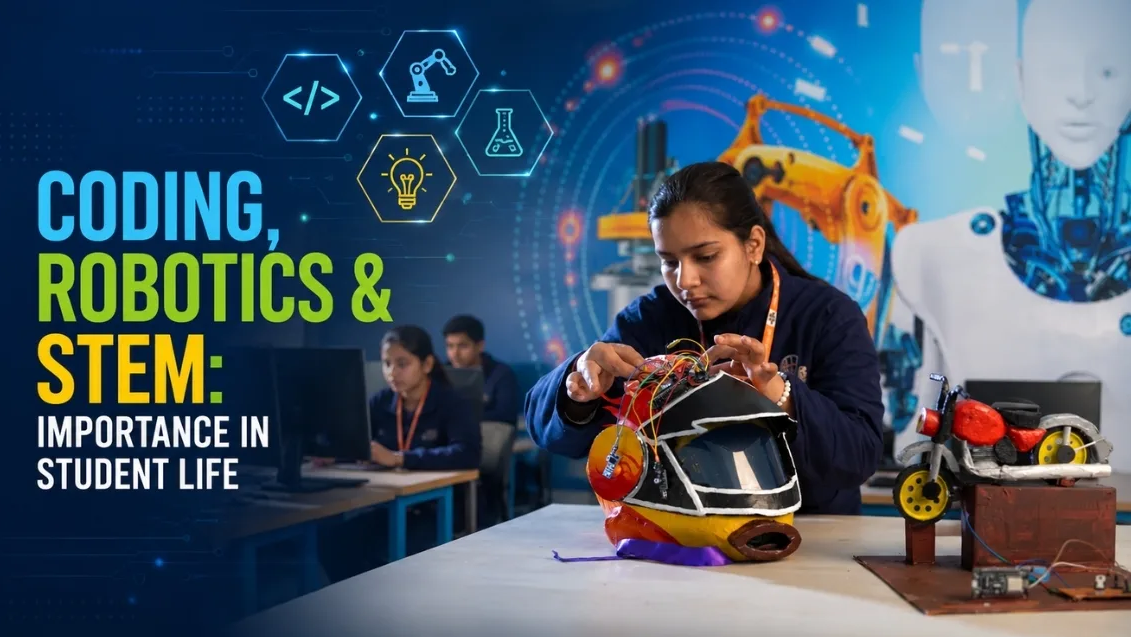
Coding Robotics and Stem Education
Coding, Robotics & STEM: Importance in Student Life
Introduction: Why STEM Skills Matter From an Early Age
Our whole world is revolving around technology and AI, and
that’s a statement that no one can deny. With the help of the internet,
technology has become an important part of our lives. Look around you: if you
want food, you can order online; if you want to go somewhere, you can book a
taxi online; and if you want to talk to someone who lives many kilometers away,
you can do that.
And with time, this technology is only going to advance, but
if schools stay the same with old knowledge and methods, our children won’t
advance, making STEM education an important part of students’ lives.
In this blog, we will discuss the importance of STEM
education in this emerging era of technology and why it matters for students to
learn.
What Are Coding, Robotics, and STEM?
Coding: Coding is the process of giving instructions to a
computer with the help of programming languages such as JAVA, PYTHON, and C++.
Learning basic coding helps students understand how digital tools work while
also developing logical thinking, creativity, and problem-solving skills.
Robotics: Robotics combines programming, engineering,
electronics, and design to create machines that can perform specific tasks.
Unlike coding, robotics mostly requires physical attention too. When students
work on robotics projects, they learn by building, testing, identifying errors,
and improving their designs.
STEM: STEM stands for Science, Technology, Engineering, and
Mathematics. STEM education connects these subjects through practical
activities, experiments, and real-world problem-solving.
Why Coding, Robotics & STEM Are Important for Students
Here are some reasons why coding, robotics, and STEM are
important for students:
1. Develops Problem-Solving Skills
Learning new skills like coding and robotics can be hard to
understand at first, creating some problems along the way, and students learn
to break these problems down into small parts, helping them develop
problem-solving skills.
2. Encourages
Creativity and Innovation
Students learn to create a picture of what they are coding
and turn their ideas into working projects, encouraging them to experiment and
think beyond conventional solutions.
3. Strengthens Logical and Critical Thinking
Students learn to analyze situations, identify patterns, and
make logical decisions with programming and STEM, helping them learn logical
reasoning.
4. Makes Learning More Practical
The past of learning revolved around books and theoretical
learning, but STEM education is more geared towards practical learning.
5. Builds Collaboration and Communication
Many STEM projects require teamwork and collaboration to
help divide the workload; this helps students learn teamwork and build
communication skills.
6. Prepares Students for Future Careers
Technology is influencing almost every industry. Early
exposure to STEM skills gives students a foundation that can support future
studies and careers in technology, engineering, science, healthcare, finance,
and many other fields.
Benefits of Introducing STEM Learning at an Early Age
Here are some benefits of STEM learning at an early age:
1. Builds Curiosity
Children are quick learners, and they don’t shy away from
asking questions. With STEM education, they learn about many new things and how
to work on them, helping to increase their curiosity.
2. Develops a Growth Mindset
When a coding project or experiment doesn't work, students
learn to identify mistakes, try again, and improve their approach.
3. Improves Confidence
Completing a project or solving problems during a project
helps motivate them and encourages them to take on new challenges.
4. Connects Classroom Learning to Real Life
STEM learning largely depends on practical applications.
Students can see how concepts from mathematics, science, and technology are
applied to solve real-world problems.
How Schools Can Introduce Coding, Robotics & STEM
Instead of introducing coding, robotics, and STEM as
technical subjects, introduce them as simple coding exercises, experiments, and
problem-solving activities that encourage students to explore how things work.
Giving projects related to robots & coding may also help
to bring STEM learning into the classroom. These activities allow them to apply
concepts from science, mathematics, and technology while learning through experimentation
and problem-solving.
Schools can also encourage STEM learning through group
projects, innovation challenges, exhibitions, and competitions. Giving students
opportunities to work together on real-world problems helps develop
collaboration, communication, creativity, and critical thinking. Most
importantly, schools should create an environment where students are encouraged
to experiment, make mistakes, and try different solutions rather than focusing
only on getting the correct answer.
Coding, Robotics & STEM at St. Xavier's World School
At St. Xavier’s World School, we take technology as a part
of our daily study sessions. Things like coding, robotics, and STEM learning
are introduced as part of a modern and practical approach to study sessions. We
encourage our students to explore technology, experiment with new ideas, and
understand how STEM concepts can be applied to solve real-world problems.
The school also focuses on using technology as a tool for
learning rather than allowing students to become dependent on it. By combining
STEM activities with classroom learning, creative projects, and teacher guidance,
St. Xavier's World School helps students develop the curiosity, confidence, and
future-ready skills needed to adapt to a rapidly changing world.
Conclusion: Coding, Robotics & STEM
Coding, Robotics, & STEM are an important part of any
student’s life. They help students develop problem-solving skills, encourage
creativity and Innovation, strengthen logical and critical thinking, make
learning more practical, build collaboration and communication, and prepare
students for future careers.
Schools can also help students learn these skills by introducing them to students through simple coding exercises, experiments, and problem-so