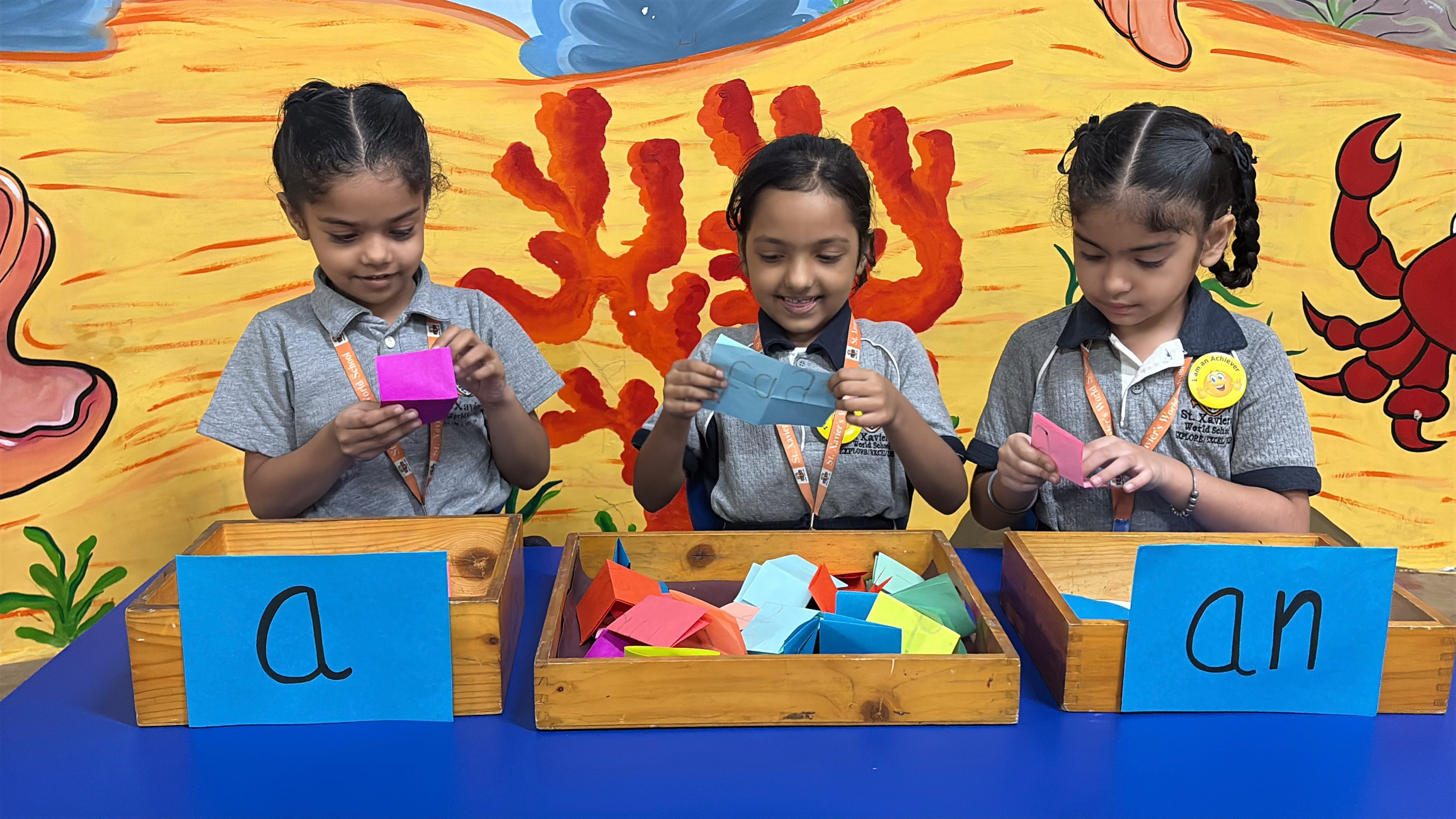
Learning Through Play
Learning Through Play: How Play Builds Young Minds
For many parents, academic success is an important part of a child’s education. In a competitive world, children often have busy schedules filled with schoolwork, homework, tuition, coaching and structured activities. While these experiences can support learning, there is another equally important element of childhood that should never be overlooked-play.
Play is often seen as entertainment or a break from serious learning. In reality, it is one of the most natural ways in which children understand the world around them. Through play, children experiment, make decisions, solve problems, communicate, imagine and learn from both success and failure.
At St. Xavier’s World School, Ghaziabad, we recognise that meaningful education is not limited to textbooks and classrooms. Opportunities to play, explore and participate actively contribute significantly to a child’s holistic development.
Understanding Cognitive Development in Children
Cognitive development refers to the gradual development of a child’s ability to think, understand, remember, communicate, make decisions and solve problems. As children grow, they learn to process information, understand relationships and develop increasingly complex ways of thinking.
Play provides children with a natural environment in which these abilities can develop. Whether they are constructing something with blocks, inventing an imaginary story or participating in a team sport, children are constantly thinking, making choices and responding to their surroundings.
Different Forms of Play, Different Learning Benefits
Not all play looks the same, and different forms of play support different aspects of development.
1. Imaginative Play: Creating Possibilities
When children pretend to be doctors, teachers, astronauts, chefs or superheroes, they enter a world of imagination. Such pretend play encourages creativity while helping children develop language, communication and storytelling skills.
It also encourages them to plan, organise their thoughts and consider different perspectives. A simple imaginary game can therefore involve surprisingly complex thinking.
2. Constructive Play: Building and Solving
Building blocks, puzzles, clay, LEGO-style construction and craft activities allow children to create something using their own ideas.
Constructive play can strengthen problem-solving and logical thinking while developing fine motor coordination and spatial awareness. Children learn that different approaches can lead to different results-and that mistakes can often be corrected by trying again.
3. Physical Play: Active Bodies, Active Minds
Running, jumping, climbing, cycling, swimming and playing sports are essential components of a healthy childhood. Physical play helps children develop balance, coordination, flexibility and physical strength.
Team sports such as football, cricket, basketball and other group activities also provide valuable social experiences. Children learn to cooperate, communicate, follow rules, handle competition and work towards a common goal.
4. Board and Rules-Based Games: Learning to Think Strategically
Chess, carrom, ludo and other board games introduce children to rules, turn-taking, strategy and decision-making.
They also provide opportunities to experience both winning and losing. Learning to manage disappointment, wait patiently, negotiate and respect another player’s perspective can contribute to emotional regulation and social development.
5. Free Play: Space to Think Independently
Free play is perhaps one of the most valuable forms of play because it allows children to decide what they want to do and how they want to do it.
Without a fixed objective or adult-directed instructions, children have the opportunity to experiment, create their own games, encounter challenges and find solutions independently. This can nurture curiosity, confidence, creativity and decision-making.
Why Play Matters in a Screen-Filled World
Children today have access to more digital entertainment than ever before. While technology can have educational value when used appropriately, excessive passive screen time can reduce opportunities for movement, face-to-face interaction and imaginative play.
Parents can create a healthier balance by setting reasonable screen boundaries and making time for outdoor and creative activities. Children do not need every moment of the day to be structured. Sometimes, even being bored can encourage them to invent a game, create a story or explore their surroundings.
Making Time for Play at Home
Parents can support play-based development through a few simple choices:
Treat playtime as an important part of the daily routine.
Encourage outdoor activities and interaction with other children.
Provide age-appropriate puzzles, books, blocks, art materials and games.
Avoid filling every afternoon with structured classes.
Participate in play occasionally and let children lead the activity.
Create healthy boundaries around recreational screen use.
Allow children the freedom to make mistakes and try again.
The objective is not to eliminate structured learning but to create a healthy balance between learning, activity, rest and play.
How Schools Can Encourage Learning Through Play
Schools have an important role in creating opportunities where children can learn actively. Activitybased learning, sports, creative arts, experiential projects, puzzles, group activities and ageappropriate games can make learning more engaging while developing important life skills.
At St. Xavier’s World School, Ghaziabad, opportunities for sports, physical activities, experiential learning and co-curricular engagement complement classroom education. Such experiences encourage students to explore their interests, collaborate with peers and develop confidence beyond academic achievement.
Play Is Not a Break from Learning
For children, play and learning are not opposing ideas. Play is learning in action. It teaches children how to think, communicate, cooperate, experiment, solve problems and manage emotions.
In a world where academic achievement can sometimes dominate a child’s schedule, giving children sufficient time and space to play is an investment in their overall development. When schools and families work together to protect this essential part of childhood, children can grow into confident, curious and capable individuals.
At St. Xavier’s World School, Ghaziabad, we believe that education should give children opportunities not only to learn, but also to explore, experience, create and enjoy the journey of growing up.