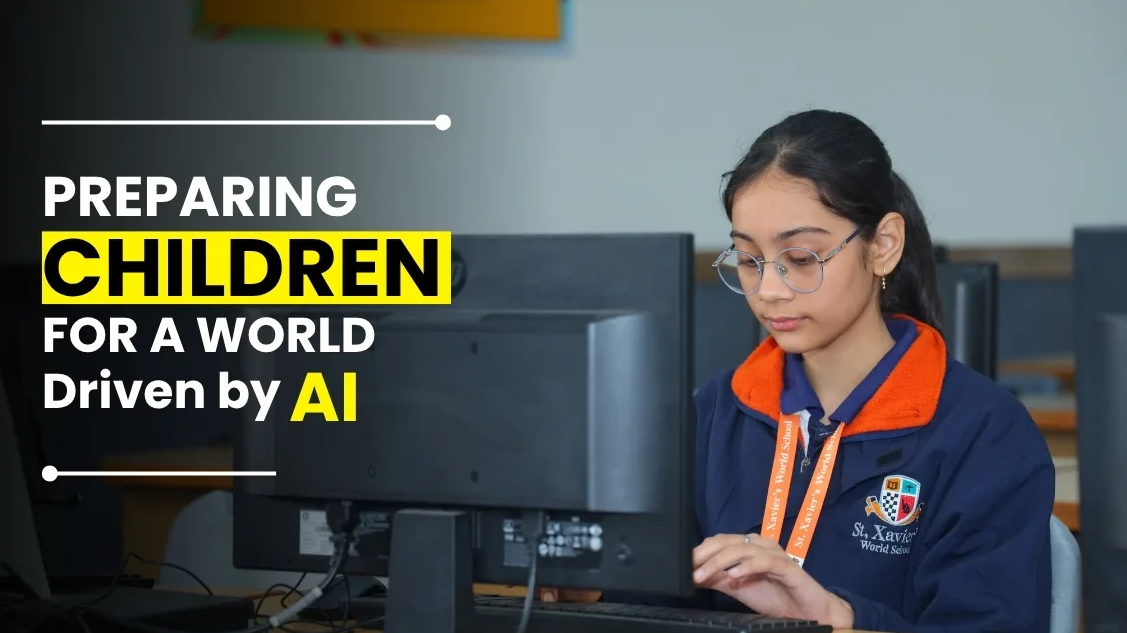
Preparing Children for a World Driven by AI
Preparing Children for a World Driven by AI
Introduction: How AI Is Changing the Future of Education
AI has taken over every place on the internet. Everyone from professionals to parents is talking about AI nowadays and using it in some form. Artificial intelligence and digital innovation are changing how industries work and how people solve problems.
To prepare children for this AI-driven future, it’s important to teach AI in schools as a subject to help students stay updated with the world and become powerful leaders of tomorrow. However, including AI in the syllabus doesn't mean it should replace traditional education or teachers. Instead, it should be used as a tool to enhance learning, encourage curiosity, and help students develop future-ready skills.
While teaching AI and making students' lives easier, it is important to teach them how to use AI wisely without compromising critical thinking, creativity, or the ability to make informed decisions. In this blog, we will discuss why including AI in education is important and how schools can help students become responsible users of this powerful technology.
What Is AI in Education?.
AI in education means the use of AI models like ChatGPT, Claude, Gemini, and Meta AI to personalize learning for students, automate administrative tasks, and improve learning outcomes.
Why AI Literacy Is Important for Students
As mentioned in the introduction, the use of AI has become a part of everyday life. Students need to know how to use it efficiently without compromising creativity and critical thinking, so they can excel both professionally and personally. AI literacy is not just about knowing how AI works; it is about learning when and how to use it effectively while still thinking independently. Here are some reasons why AI proficiency is important for students:
1. Prepares Students for Future Careers
Many industries, such as healthcare, technology, marketing, and engineering, use AI daily to improve business efficiency and growth. Learning AI in school gives students a huge advantage when entering these industries.
2. Develops Digital Literacy
When digital tools are used in schools, students learn digital skills, use AI responsibly and evaluate online information critically. It also helps students understand the difference between using AI as just a tool and not totally depending on it.
3. Supports Personalized Learning
With each lesson, AI develops an understanding of the user, and with time, it learns the student's learning pace, strengths, areas for improvement and interests. This personalization helps students learn more effectively and develop confidence in the classroom.
4. Enhances Problem-Solving Skills
When used efficiently, AI encourages students to ask deeper and more specific questions. This increases their knowledge and understanding, developing problem-solving skills in students.
5. Promotes Responsible Use of Technology
Teaching students how to use AI ethically helps them avoid becoming overly dependent on technology. Students start using it as a tool for research, creativity, and learning while not forgetting about developing critical thinking, originality, and independent decision-making skills.
Advantages and Disadvantages of Using AI in Education
Advantages of AI in Education
AI can adapt lessons according to each student's learning pace and abilities, making learning more effective.
AI-powered tools provide immediate explanations, corrections, and suggestions, helping students learn from their mistakes quickly.
AI makes learning more accessible through features like text-to-speech, language translation, and personalized support for diverse learners.
Interactive quizzes, educational games, simulations, and virtual tutors make lessons more interesting and enjoyable.
Students can revise concepts, practice exercises, and explore new topics outside the classroom at their own pace.
AI helps students organize information, summarize concepts, and access learning resources quickly, allowing more time for understanding and practice.
Disadvantages of AI in Education
Students may rely too much on AI for answers instead of developing their own thinking and problem-solving skills.
Excessive use of AI can discourage students from analyzing problems and finding solutions independently.
AI-generated responses are not always accurate, so students must verify information from reliable sources.
Many AI tools collect user data, making it important to protect students' privacy and use trusted platforms.
Relying heavily on AI may reduce valuable interactions with teachers and classmates, which are important for communication and social development.
If misused, AI can tempt students to complete assignments without genuinely understanding the subject.
People Also Read: Personalized Learning with AI: What Parents Should Know
How St. Xavier's World School Prepares Students for an AI-Driven Future
At St. Xavier’s World School, we believe that AI should be a part of our teaching, not something that replaces it. We prepare students for the future by combining modern teaching methods with strong academic foundations, ensuring they develop both digital proficiency and essential life skills.
With the help of activity-based learning and AI-driven technology, we provide modern school education to students and prepare them for the future while strengthening their critical thinking, creativity, communication, and problem-solving abilities.
Our teachers guide students to use AI as a tool that supports research, exploration, and innovation, not as a thing to be dependent on. By balancing AI-enabled learning with human interaction, collaborative activities, and experiential education, we help students become confident and future-ready individuals.
Conclusion: Preparing Children for an AI-Driven World
The world is driving towards AI, and people who are still not learning about it are getting left behind, making it important to teach it to students from a young age. By using generative engines like ChatGPT, Claude, Gemini, and Meta AI in education, we are providing children with a tool that helps them get their work done efficiently in less time.
However, it is also important to help them understand that these are just tools, and they cannot depend on them, as it could lead to a decrease in creativity, critical thinking, and problem-solving.
At St. Xavier’s World School, we believe that combining the knowledge of our teachers with AI helps our students become ready for a digitally evolved world while having creativity, critical thinking, and problem-solving skills in them. Contact Us now to shape your child's life into becoming a better part of an AI-powered world.