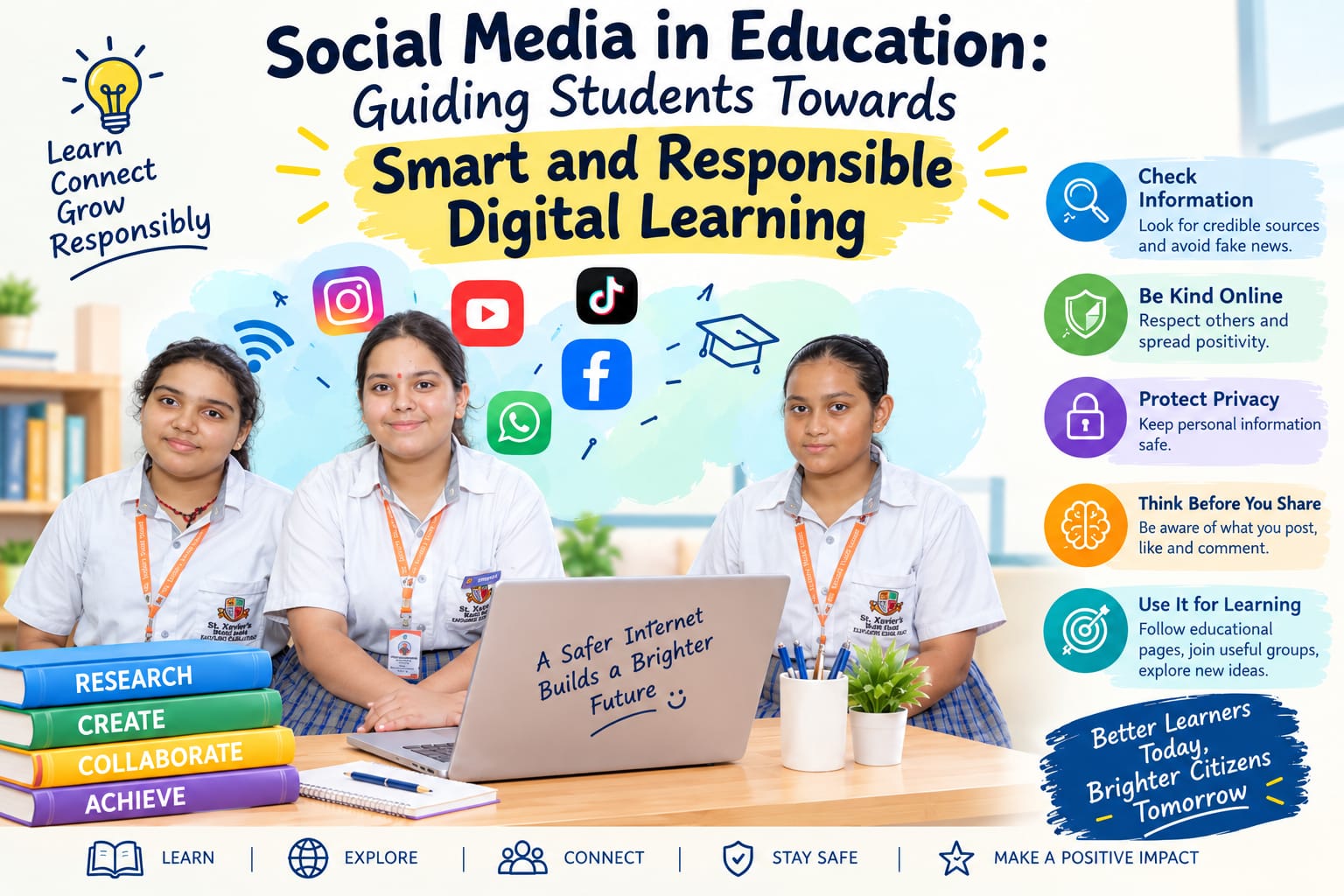
Social Media in Education
Social Media in Education: Guiding Students Towards Smart and Responsible Digital Learning
The way students learn has changed dramatically in the digital age. A classroom discussion can continue through a messaging group, a difficult science concept can be understood through an online video, and a student can discover a new area of interest through a social media post. Social media and education are no longer separate worlds-they increasingly influence how young people learn, communicate, collaborate, and understand the world around them.
For parents exploring a school that prepares children for the future, the question is no longer simply whether students should use social media. The more important question is: How can students learn to use digital platforms safely, purposefully, and responsibly?
At St. Xavier’s World School, Ghaziabad, we believe that education must evolve with the world students live in. Social media can be a powerful learning resource when combined with digital literacy, responsible guidance, appropriate boundaries, and critical thinking.
Social Media Has Become Part of Modern Learning
For today's students, digital platforms are more than entertainment spaces. They can provide access to educational videos, expert opinions, demonstrations, current affairs, creative ideas, and communities focused on specific interests.
A student interested in astronomy can follow space-related organisations. Someone curious about coding can access tutorials and demonstrations. Another student may discover an interest in art, photography, environmental conservation, entrepreneurship, or public speaking through content encountered online.
The important skill is learning to distinguish useful digital engagement from mindless consumption.
Making Knowledge More Accessible
One of the greatest advantages of social media is the accessibility of information. Educational creators, institutions, museums, scientists, authors, and organisations regularly share informative content through digital platforms.
Videos, animations, demonstrations, interviews, and visual explanations can make complex subjects easier to understand. These resources can complement classroom teaching and encourage students to explore topics beyond the prescribed syllabus.
However, students must also understand that accessibility does not automatically mean accuracy. Learning how to verify information is therefore an essential part of digital education.
Encouraging Curiosity and Self-Directed Learning
Children are naturally curious, and social media can sometimes provide the spark that encourages them to investigate a subject further.
A short video about robotics may lead a student to research engineering. A post about climate change may inspire a project on sustainability. A discussion about literature may encourage a child to explore a new author.
This kind of curiosity-driven learning can develop independence and encourage students to become active participants rather than passive recipients of information.
Connecting Students Through Collaboration
Digital platforms can extend learning beyond school hours. Students can use appropriate messaging groups and collaborative digital spaces to discuss assignments, exchange notes, organise projects, and clarify doubts.
When guided responsibly, digital collaboration can strengthen communication and teamwork. Students can learn to explain ideas, listen to others, divide responsibilities, and work towards a shared objective.
The key is ensuring that technology supports genuine collaboration rather than becoming another source of distraction.
Developing Communication and Digital Skills
The ability to communicate effectively online is increasingly important. Future workplaces will require students to understand digital communication, online etiquette, information sharing, collaboration, and responsible content creation.
Schools can help students understand that digital communication carries the same responsibility as face-to-face communication. Respectful language, thoughtful responses, privacy awareness, and responsible sharing are important elements of good digital citizenship.
Understanding the Challenges of Social Media
While social media offers opportunities, its challenges cannot be ignored.
Distraction and Loss of Focus
Social media platforms are designed to attract attention through notifications, recommendations, short-form content, and endless scrolling. A student who intends to spend a few minutes online can easily lose valuable study time.
Constant switching between academic work and entertainment can also make sustained concentration more difficult.
Impact on Sleep and Daily Routines
Late-night social media use can interfere with healthy sleep routines. Students who stay online late may find it harder to concentrate the following day and may feel tired or irritable.
Maintaining device-free periods before bedtime can therefore be an important part of healthy digital habits.
Misinformation and Superficial Learning
Not everything students see online is reliable. Misleading claims, edited videos, inaccurate information, and sensational content can spread rapidly.
Students need to learn to ask questions such as: Who created this information? What evidence supports it? Can the claim be verified through reliable sources?
Critical thinking is one of the strongest safeguards against misinformation.
Social Comparison and Self-Esteem
Social media often presents carefully selected versions of people's lives. Constant exposure to images of achievements, appearances, lifestyles, and popularity can encourage unhealthy comparison.
Students should understand that online content rarely represents the complete reality of another person's life. Their self-worth should never depend on likes, followers, views, or online approval.
Cyberbullying and Privacy
Online bullying can be particularly distressing because it can follow students beyond the school environment. Sharing private photographs, excluding someone from groups, posting hurtful comments, or forwarding content without permission can cause serious harm.
Students must understand privacy, consent, respectful communication, and the importance of reporting inappropriate online behaviour.
Teaching Students to Become Smart Digital Citizens
The solution is not simply to ban technology. Students need the knowledge and judgement to navigate the digital world responsibly.
A useful approach is to encourage students to:
Set specific times for recreational social media use.
Switch off unnecessary notifications during study hours.
Follow reliable and educational sources.
Verify information before sharing it.
Protect passwords and personal information.
Think carefully before posting or commenting.
Treat others online with the same respect expected offline.
Maintain time for sleep, exercise, hobbies, family, and face-to-face friendships.
The Role of Parents: Guide Rather Than Simply Restrict
Parents play an important role in developing healthy digital habits. Conversations are often